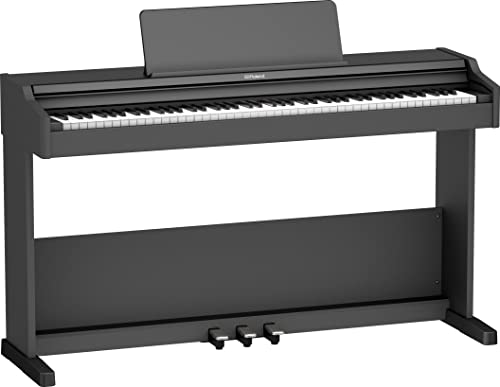
The Roland RP107 is a home digital piano in an upright-style cabinet. Roland introduced it in 2022 as one of two entry-level home models, and describes it as a family’s first piano, with sound and keyboard action derived from its higher-end instruments. This profile covers what Roland publishes about the RP107, who it suits and what to confirm before you buy. For the full ranking, see our best digital pianos of 2026 comparison.
We write from Roland’s published specifications and press release, not from our own measurements. Descriptions of how the piano feels or sounds are Roland’s wording, and we label them that way.
Who the RP107 Is For
The RP107 is built for the learner. A parent who wants a piano that a child can practice on every day gets an 88-key weighted keyboard, three pedals and a cabinet that looks like furniture. An adult beginner who plans to use apps and online lessons gets Bluetooth audio and MIDI plus Roland’s own lesson app. A returning pianist who wants a quiet, low-maintenance instrument at home gets headphone playing and no tuning.
Roland’s pitch is “when you’re on a budget and looking for your family’s first piano, authentic tone and playability should be your top priority.” The company positions the RP107 as the budget-friendly end of its home line. If you need a bigger sound or room for more voices, the Yamaha Arius YDP-165 is a rival console, and the Roland FP-60X offers a stronger speaker system in a portable body.
Keyboard and Pedals
Roland lists the 88-note PHA-4 Standard keyboard with escapement and Ivory Feel. Roland describes “true weighted response,” meaning the keys have a hammer-action resistance, with a small click near the bottom of the stroke that mimics the escapement of an acoustic piano. Roland describes Ivory Feel as a special material on the white keys. Key touch is listed as 5 types with fixed touch.
Three pedals are built into the cabinet: damper, soft and sostenuto. Roland lists the damper and soft pedals as capable of continuous detection, so half-pedaling on the damper works in principle. For a beginner, the sustain pedal is the one that matters most, but having the other two in place means a student does not need new hardware when a teacher assigns pieces that call for them.
Sound Engine and Library
The RP107 uses SuperNATURAL Piano, which Roland describes as a combination of sampling and modeling that reproduces the nuances of an acoustic grand. Roland says the tone changes naturally in response to touch and dynamics. Polyphony is listed at 256 voices, comfortable for pieces that use the pedal heavily.
The tone count needs context. Roland lists 324 total tones, but only 15 are reachable from the front panel. The other 309 are available through the Roland Piano App. If you do not plan to use the app, you have a conventional set of piano-focused sounds. Piano Designer, the feature that lets you adjust lid, string resonance, damper resonance, key-off resonance and individual note tuning, volume and character, works only through the app on this model. Effects listed are Ambience and Brilliance.
Internal Songs and the Roland Piano App
For a student, the song library is a practical selling point. Roland lists 377 internal songs. Of these, 10 are for listening, 30 for ensemble playing, 20 for entertainment, 30 are “Let’s Sing with DO RE MI” and 287 are lesson pieces covering scales, Hanon, Beyer, Burgmüller and Czerny’s Op. 100.
The free Roland Piano App for iOS and Android controls sound selection, metronome settings and recording. Roland describes an activity log with goals, flash card games, rhythm exercises and a One Week Master program for learning pieces, plus scores for the RP107’s internal songs. Roland says membership tiers of Roland Cloud unlock more sheet music. The company also notes that support for apps may end without notice, so check compatibility with your device.
Speakers, Headphones and Connectivity
Roland lists two 4-3/4 in (12 cm) speakers rated at 8 W each. That is gentle for a console. It will fill a bedroom or a small living room at normal practice volume, but do not expect it to compete with an acoustic upright in a big space. Roland also lists a Speaker Auto Mute function.
Two headphone jacks (a stereo mini and a 1/4-inch) allow side-by-side playing, and Twin Piano mode lets a student and a teacher or friend play side by side. Headphones 3D Ambience is listed as the headphone effect.
Bluetooth is version 4.2 with A2DP audio and MIDI over Bluetooth Low Energy. You can stream music or a lesson through the piano’s speakers or use apps like GarageBand over MIDI. A USB Type B computer port and a USB Type A memory port complete the connections. Recording is limited: the recorder stores one song with one part of about 500 KB. If you want to record longer or multitrack sessions, plan to use a computer or app.
Cabinet, Size and Weight
The cabinet has a slide-out keyboard cover and a built-in music rest, made from plastic with a fixed angle and holders. Roland lists 54-1/4 in wide, 16-3/16 in deep and 38-11/16 in high with the music rest. Weight is 82.0 lb (37.0 kg). That is about 10 lb lighter than the Yamaha YDP-165’s 92 lb 10 oz, which makes it easier to place, and Roland says two people can move it between rooms.
Power draw is low, at 8 W with the included AC adaptor, and about 4 W when playing at medium volume. The RP107 comes with an owner’s manual, assembly leaflet, AC adaptor and power cord. Headphones are sold separately.
How It Compares
The Yamaha Arius YDP-165 is the other home console in our lineup, and the shopping decision between them often comes down to features versus feel. The RP107 lists Bluetooth, the Roland Piano App and a very large lesson library. The YDP-165 lists higher-rated 20 W x 2 speakers and Yamaha’s GH3 keyboard with CFX sampling.
Against the portable Roland FP-60X, the RP107 shares the PHA-4 Standard keyboard and SuperNATURAL engine. The trade is permanence and built-in pedals against mobility, more voices, more speaker power and a mic input.
What to Check Before You Buy
- Confirm the listing includes a bench, since Roland’s specifications do not list one.
- Measure the space for 54-1/4 in of width and a weight of 82 lb.
- Decide whether you will use the app. If not, 15 front-panel tones are what you have.
- Check that your phone or tablet supports the Roland Piano App.
- Check the finish and assembly requirements in the listing. Roland includes an assembly leaflet.
Our verdict: an affordable, lesson-friendly console with a respectable keyboard and sound engine, strongest for families and adult learners who will lean on the app.
Sources
See price on Amazon