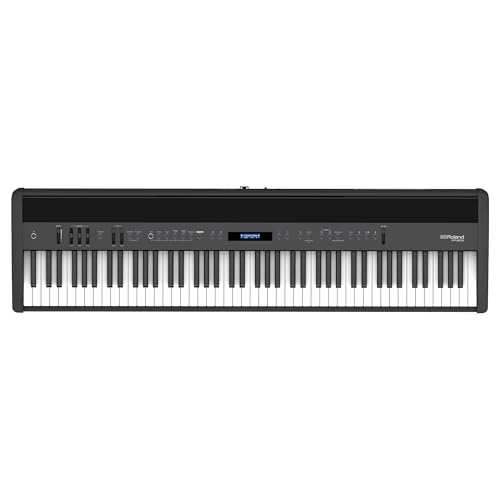
The Roland FP-60X is the middle of the FP-X range and the one Roland calls the “upper-range choice” for serious performance with an eye on budget. It keeps the same SuperNATURAL sound engine and PHA-4 Standard keyboard as the cheaper models, then adds more sounds, ambience effects, stronger speakers and an immersive headphone mode. This profile explains what Roland publishes about the FP-60X, who it suits and where its limits are. For the full ranking, see our best digital pianos of 2026 comparison.
We write from Roland’s published specifications and press materials, not from our own measurements. Roland’s descriptions of how the piano “plays” are the company’s own claims, and we mark them as such.
Who the FP-60X Is For
The FP-60X fits a player who has outgrown a starter keyboard and wants a bit more to work with. That might be an adult returning to piano after years away, a student moving from beginner lessons to repertoire, or a hobbyist who wants a few electric piano, organ and string sounds as well as a grand. It also suits a household that wants good headphone sound for late-night practice, since Roland lists a Headphones 3D Ambience feature on this model.
It is a reasonable choice for small gigs, too. Roland describes the stereo speaker system as powerful enough for performing at a small venue, and the mic input with effects lets a singer play and sing through one box. If key feel matters most to you, look at the Roland FP-90X, which has a different keyboard. If you want a cabinet instead of a portable slab, the Roland RP107 offers the same keyboard type in a home console.
Keyboard: PHA-4 Standard
Roland lists an 88-key PHA-4 Standard keyboard with escapement and ivory feel. In Roland’s words, it puts the hammer action and escapement of a quality acoustic instrument under your fingers, right down to the “click” as each key is pressed. Roland lists 100 types of key touch plus a fixed option, and a Hammer Response setting with 10 types.
This is the same keyboard name Roland uses on the FP-30X and the RP107, so the FP-60X does not give you a different action from the cheaper models. That matters when you decide where to spend. The extra money buys you speakers, sounds and effects, not a different touch.
Sound Engine and Sound Library
The FP-60X uses SuperNATURAL Piano, which Roland describes as a way to capture nuance from pianissimo to fortissimo. Polyphony is listed at 256 notes. Roland lists 16 piano tones, 18 electric piano tones, 18 organ tones, 27 strings and pad tones and 279 synth and other tones, including 8 drum sets and 1 SFX set. That is a smaller piano set than the FP-90X’s 20 piano tones, but the non-piano library is the same size.
Piano Designer lets you shape the sound with settings for lid position, string resonance, damper resonance, key-off resonance and individual note tuning, volume and character, and you can change them on the piano or in the Roland Piano App. A 3-band equalizer sits on the front panel with sliders, which is handy when you move between rooms.
Ambience is where the FP-60X moves above the lower models. Roland lists four ambience types (Studio, Lounge, Concert Hall and Cathedral) with 11 depth levels, and My Stage provides 8 stored setups. There are 32 internal songs for practice.
Speakers and Headphones
Roland lists two 3-3/16 x 4-3/4 in (8 x 12 cm) speakers rated at 13 W each, which the product page describes as a 26-watt stereo speaker system. That is more power than the FP-30X, according to Roland, but clearly less than the FP-90X, which has 25 W main speakers and 5 W tweeters. For a living room or practice room, it is adequate. For a loud band rehearsal, you will want to plug into an amplifier through the output jacks.
For private practice, Headphones 3D Ambience is Roland’s immersive mode, designed to make the sound feel as though it is coming from the piano rather than inside your head. Two headphone jacks allow a teacher and a student to listen together.
Connectivity and Recording
Roland lists Bluetooth audio (version 3.0) and Bluetooth MIDI (version 4.0). Audio lets you stream a lesson video or backing track through the piano’s speakers, while MIDI links to apps such as Roland’s Zenbeats and Apple’s GarageBand. The USB computer port supports USB MIDI and audio, and the USB memory port accepts a flash drive of up to 32 GB for WAV and MP3 playback and WAV recording.
The recorder stores 100 MIDI songs and 200 audio songs, each audio recording up to 80 minutes. The rest of the practical set includes a metronome with Tempo Coach, transposition, Dual and Split modes, Twin Piano, 45 registrations and ten historical temperaments. On the back you will find stereo outputs, a mic input with a gain knob, an input jack, a DC jack and pedal jacks for damper, sostenuto and soft. The damper pedal supports continuous detection, which suits half-pedaling.
Size, Weight and Stands
Roland lists the body at 50-7/8 in wide, 13-9/16 in deep and 5 in high with the music rest detached. Weight is 42 lb 9 oz (19.3 kg) with the music rest. Roland offers the KSC-72 stand and KPD-90 three-pedal unit for an upright-style setup, and with those and the music rest the weight rises to 72 lb 13 oz (33.0 kg) at a height of 37 in. For portable use, the KS-20X stand and RPU-3 pedal unit are options. It comes in black or white.
How It Compares
Compared with the FP-90X, the FP-60X gives up the wood-hybrid PHA-50 keyboard, the Pure Acoustic Piano Modeling engine and the four-speaker array, and it weighs about 10 lb less. Compared with the FP-30X below it, Roland lists more sounds, ambience effects, speaker power and the 3D headphone feature. That makes it a clear fit for a buyer who wants everything except a premium action.
The Roland RP107 is the home-console alternative with the same PHA-4 Standard keyboard, built-in pedals and a lesson-oriented song library. It is not portable, but it makes sense if the piano stays in one place.
What to Check Before You Buy
- Decide on a stand and pedals. The KSC-72 and KPD-90 are optional, and a basic sustain pedal is a minimum for piano study.
- Confirm black or white, and what is included in the box with your listing.
- If you plan to play with a band or in a bigger room, factor in an external amplifier.
- If you care most about key touch, compare it with the FP-90X before deciding.
- Check that the Roland Piano App supports your phone or tablet. Roland notes that app support may end without notice.
Our verdict: a strong middle option in the FP-X range, with more sound and speaker power than the entry models and the same keyboard, best for improving players who do not need a flagship action.
Sources
See price on Amazon