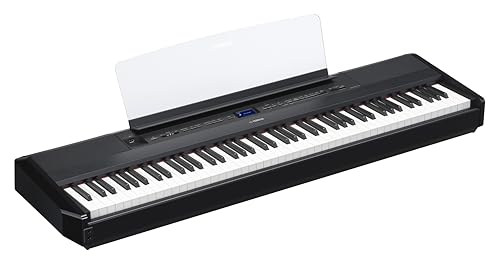
The Yamaha P-525 is the flagship of Yamaha’s P Series of portable digital pianos. According to Yamaha, it combines wooden keys, two concert grand piano voices and a full set of other keyed-instrument voices in a design meant for home playing and small live performances. This profile covers the specs Yamaha publishes, where the P-525 is strong, where it asks you to compromise and who it suits. For the full ranking, see our best digital pianos of 2026 comparison.
We work from Yamaha’s published specifications and not from our own measurements. Claims about how a piano “feels” are Yamaha’s descriptions, and we label them that way.
Who the P-525 Is For
Yamaha recommends the P-525 for players who want authentic piano feel in a portable instrument, and that matches how it is built. It suits an intermediate or advanced pianist who wants a wooden-key action without buying a full console piano. It suits teachers and performers who need to move an instrument between a studio and a venue. It also suits a household that wants one good piano that can be put on a stand at home and taken to a rehearsal.
It is a harder sell for a child’s first instrument or for someone not sure they will keep playing. The action is more refined than a beginner needs, and you pay for it in weight and in budget. If you are in that position, look at the compact models in our lineup first and come back later.
Keyboard: GrandTouch-S Wooden Keys
Yamaha lists an 88-key GrandTouch-S keyboard with wooden keys (white keys only), escapement and synthetic ebony and ivory keytops. The company says this is the same family of keyboard used in its top Clavinova digital pianos, and that it replaces the older NWX keyboard from the P-515. Yamaha describes the keys as solid wood with a laminated structure that resists warping, and says they respond to differences in how hard, quickly and heavily they are played.
Touch sensitivity has five adjustable levels plus a fixed setting: Hard 2, Hard 1, Medium, Soft 1 and Soft 2. Anyone who finds the default response too heavy or too light has room to adjust, and a player with strong hands can choose the stiffer curve.
Sound: Two Concert Grands and Modeling
The P-525 uses two concert grand voices. According to Yamaha, the Yamaha CFX has a sparkling treble and powerful bass, and the Bösendorfer Imperial has a warm “Viennese” tone. Yamaha lists 44 voices in total, including the CFX and 11 other piano voices, 9 electric piano voices and 6 organ voices, plus harpsichord, strings and guitar. There are also 18 drum and SFX kits and 480 XG voices, and maximum polyphony is 256 notes.
Two modeling systems shape the sound. Virtual Resonance Modeling (VRM) simulates the vibration and sympathetic resonance of the strings, damper, body and duplex scaling of a grand, and Grand Expression Modeling tracks the speed and intensity of your playing. Binaural sampling is listed only for the “CFX Grand” voice. With headphones it is designed to sound as though the piano is in front of you, and Yamaha’s Stereophonic Optimizer applies a similar effect to the other piano voices. Intelligent Acoustic Control adjusts bass and treble based on volume, so quiet practice sounds less thin.
Speakers and Amplification
Yamaha lists a two-way speaker system with an amplifier rating of (20 W + 6 W) x 2. The speakers are oval 4-3/4 x 2-3/8 inch (12 x 6 cm) woofers plus 1 inch (2.5 cm) dome tweeters, and Yamaha says they are angled toward the player. Flared bass reflex ports and sound-absorbing tubes are meant to reduce wind and vibration noise from the speaker boxes. For a home setting that is plenty, and the built-in Sound Boost and three-band EQ options help in a band mix.
Connectivity and Recording
The P-525 lists Bluetooth audio and MIDI, which Yamaha notes varies by area. On the back are two headphone jacks, MIDI in and out, an aux input, aux outputs, a USB to Device port (Type A) and a USB to Host port (Type C). It works as a USB audio interface at 44.1 kHz, 16-bit stereo, so you can record piano directly to a computer.
Yamaha’s Smart Pianist app can control nearly every function from a phone or tablet. Onboard recording supports 250 MIDI songs with 16 tracks each, and audio recording to a USB flash drive of up to 80 minutes per song. Other practical features include Dual, Split and Duo modes, 40 rhythms, a metronome with a tempo range of 5 to 500 and registration memory with 6 buttons across 4 banks. There are 71 preset songs, made up of 21 voice demos and 50 classics.
Pedals, Stand and Size
Pedals deserve attention here. Yamaha includes the FC3A sustain pedal, which supports half-pedaling. For three pedals you need the optional LP-1 or FC35 unit, and for a furniture-style stand you need the optional L-515. Yamaha says the assignable pedal functions include continuous sustain, sostenuto, soft and more. If you are going to practice repertoire that uses the sostenuto or soft pedal, plan for the LP-1.
Yamaha lists the body at 52-5/8 in wide, 5-11/16 in high and 14-13/16 in deep, or 12-15/16 in high and 15-7/8 in deep with the music rest. Weight is 48 lb 8 oz (22.0 kg). With the L-515 stand, the height is 29-13/16 in (37 in with the music rest). That makes the P-525 portable but clearly heavier than the compact P-series models, and the packing box is 57-3/8 in long, so check your doorways and car.
How It Compares
The obvious rival in our lineup is the Roland FP-90X. Both are flagship portables with premium actions, and the contrast is in the keyboard design. Yamaha uses wooden keys with synthetic keytops, while Roland uses a wood and plastic hybrid, and each has its own piano voice approach. Neither is objectively better, so touch is the tiebreaker.
If you want a console cabinet with a built-in stand and three pedals, the Yamaha Arius YDP-165 is the home-furniture alternative. It uses Yamaha’s GH3 keyboard instead of wooden keys and lists 10 voices instead of 44, but it is designed to stay in one place.
What to Check Before You Buy
- Decide on pedals. The included FC3A is a single sustain pedal, and the LP-1 or FC35 adds three-pedal control.
- Decide whether you want the L-515 stand or a different one.
- Check whether Bluetooth is available in the U.S. version you buy, since Yamaha says availability varies.
- Confirm that the listing is the P-525 and the finish you want.
- Try the keys in a store if possible, because wooden-key actions are a matter of preference.
Our verdict: the P-525 is Yamaha’s best portable for players who care about key feel, with a rich voice set and strong connectivity, and a bigger step than a beginner needs.
Sources
See price on Amazon