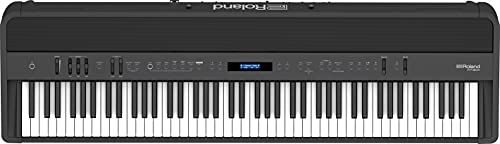
The Roland FP-90X sits at the top of Roland’s FP-X portable piano family. Roland calls it the “flagship portable piano” and describes it as the pinnacle of its piano technology in a slim cabinet. This profile walks through what Roland publishes about the keyboard, the sound engine and the speakers, then sorts out who should buy it and who can pay less for a model that does the job. For the full ranking, see our best digital pianos of 2026 comparison.
We write from the manufacturer’s published specifications and a press release, not from our own measurements. Where a point is Roland’s claim rather than a verifiable fact, we say so.
Who the FP-90X Is For
The FP-90X fits three kinds of players. The first is the serious home pianist who wants a keyboard that feels close to an acoustic grand and does not want to outgrow it in two years. The second is the gigging or teaching musician who needs one instrument that sounds big enough for a small room, moves between locations and offers a mic input for singing. The third is the returning player who knows what a good action feels like and is willing to pay for it.
It is less obvious for a family buying a first piano. Nothing is wrong with it, but you would be paying for a wood-hybrid action, a four-speaker array and a modeling engine whose difference a beginner may not hear for a year or two. If that describes you, the Roland FP-60X gives you the same series look and Bluetooth features with a simpler keyboard and speaker setup.
Keyboard: PHA-50 Hybrid Action
The keyboard is the main reason to choose this model. Roland lists the 88-key PHA-50 as a wood and plastic hybrid structure with escapement and an ebony/ivory feel. Roland’s product page explains the idea: the warm touch of the wood sides is meant to be familiar to seasoned players, while a composite center frame runs from the front of the keys to the back for stability and durability. Roland says the same PHA-50 keyboard is found in its top-level home pianos.
Escapement is the small, soft “click” you feel near the bottom of a key press on a grand piano, as the hammer releases from the key. Teachers care about it because it affects how you play very quiet notes and fast repeated passages. Roland also lists 100 types of key touch, a fixed-touch option and a Hammer Response setting that can be turned off or set to one of 10 types, so you can adjust how the keys respond to velocity.
Sound Engine and Piano Designer
According to Roland, the FP-90X uses Pure Acoustic Piano Modeling, a sound engine that models how an acoustic grand creates its tone rather than simply playing back a recording. The page describes eight ready-to-play piano variations across Concert and Stage categories. Roland lists limitless polyphony for solo piano playing with tones 1 through 8, and 256 voices for other tones.
The onboard Piano Designer lets you adjust things such as lid position, key-off noise, hammer noise, duplex scale, full-scale string resonance, cabinet resonance, soundboard type, damper noise and soft pedal type. You can make those changes on the piano or through the Roland Piano App. Beyond pianos, Roland lists 20 piano tones, 18 electric piano tones, 18 organ tones, 27 strings and pad tones, and 279 synth and other tones, including 8 drum sets and 1 SFX set.
Ambience effects are broader than on the lower models. Roland lists Pure Acoustic Ambience with six types (Studio, Lounge, Concert Hall, Wooden Hall, Stone Hall and Cathedral) and 11 depth levels. My Stage provides 12 stored setups.
Speakers and Headphones
Here the FP-90X separates itself from the rest of the family. Roland lists a four-speaker system: two 3-3/16 x 4-3/4 in (8 x 12 cm) speakers rated at 25 W each and two 1 in (2.5 cm) dome tweeters rated at 5 W each, with vents on the back of the cabinet. Roland says no other FP-X piano matches its sonic depth and dynamic range. That is a manufacturer claim, but the spec sheet backs up the direction: the other models in the line are listed with fewer and less powerful speakers.
For quiet practice, Roland lists Headphones Acoustic Projection, and there are two headphone jacks (a 1/4-inch and a mini jack) so a teacher or a child can listen alongside you.
Connectivity and Recording
The FP-90X includes Bluetooth audio (version 3.0) and Bluetooth MIDI (version 4.0). Audio lets you stream a backing track or a lesson video through the piano’s speakers, and MIDI connects to composition apps like GarageBand. The USB computer port supports both MIDI and audio, and a separate USB memory port accepts a flash drive of up to 32 GB for audio files in WAV or MP3 and for recording.
Roland lists a MIDI recorder with 100 songs and an audio recorder with 200 songs of up to 80 minutes each. Other practical features include a metronome with Tempo Coach, transposition, dual and split modes, Twin Piano, 34 internal songs, 45 registrations, a mic input with compressor, doubling and echo effects, and 10 historical temperaments. The rear panel has pedal jacks for damper, sostenuto and soft, with a DP-10 damper pedal supporting continuous detection.
Size, Weight and Setup
Roland lists the body at 52-13/16 in wide, 15-3/8 in deep and 5-3/8 in high with the music rest detached, and 52 lb 1 oz (23.6 kg) with the music rest. That is light for a hammer-action 88-key instrument but still a real piece of equipment for one person to carry up stairs. Roland says it is easy to transport and store in a closet or vehicle.
To make it feel like an upright, you add the optional KSC-90 stand and KPD-90 three-pedal unit. With those and the music rest, Roland lists 83 lb 6 oz (37.8 kg) and a height of 36-3/4 in. For portable use, Roland also lists the KS-20X stand and the RPU-3 pedal unit. The FP-90X comes in black or white finishes, and Roland lists power consumption of about 14 W while playing at medium volume.
How It Compares
Within the FP-X family, Roland positions the FP-60X as the “upper-range choice” for serious performance on a budget. It shares the SuperNATURAL engine and PHA-4 Standard keyboard with the models below it, while the FP-90X moves up to PHA-50 keys and Pure Acoustic Piano Modeling. If wood in the key structure and a fuller speaker system matter to you, the FP-90X justifies the step up. If you mostly play with headphones, much of the difference moves to the keyboard.
Across brands, the closest rival in our lineup is the Yamaha P-525, which uses solid wooden keys and a different piano voice approach. We cover the head-to-head in the comparison, because the choice often comes down to which action and sound character you prefer under your fingers.
What to Check Before You Buy
- Decide whether you need the stand and three-pedal unit, and budget for them if you do. They are optional accessories.
- Confirm the finish (black or white) and what the listing includes in the box.
- Plan for weight if you move it often. 52 lb 1 oz is manageable, but not as easy as a compact beginner model.
- Try to play it before you buy if you can. The feel of PHA-50 keys versus a wooden-key rival is a matter of taste.
- Check Roland’s support page for the Roland Piano App, since Roland notes that app support may end without notice.
Our verdict: the FP-90X is a very complete flagship portable for players who care about key feel and sound, and a stretch for beginners who only need the basics.
Sources
See price on Amazon