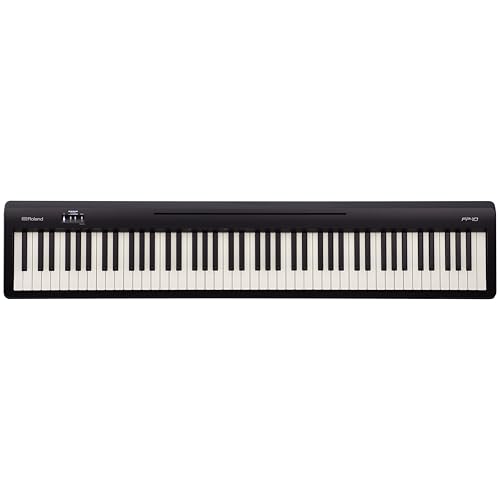
The Roland FP-10 is the entry-level model in Roland’s long-running FP series, and it brings the PHA-4 Standard keyboard found in Roland’s higher-end home pianos into a compact 88-key body. Roland calls it “the most compact 88-note digital piano in its class” and pitches it at home practice, small performances and as a second piano for experienced players. This profile gathers what Roland publishes, says who the FP-10 suits and lists what to check before you order. For the full ranking, see our best digital pianos of 2026 comparison.
We write from Roland’s published product page and its 2019 press release, not from our own measurements, and we attribute claims to Roland.
Who the FP-10 Is For
It suits beginners on a budget who want a real piano feel. Roland says the PHA-4 Standard keyboard offers hammer action, escapement and Ivory Feel white keys, with a heavier hammer weight in the low register and a lighter one in the high register. That graded behavior is what you want when learning, because it builds finger strength and control that carry over to an acoustic piano.
It suits students who will mostly play with headphones. Roland says the quiet action and the headphone output let you play any time without disturbing others. The single headphone jack is enough for one player.
It suits small spaces. Roland lists a width of 50-9/16 inches, a depth of 10-3/16 inches and a weight of 27 lb 13 oz (12.6 kg) with the music rest detached. Roland’s FP-X lineup page places it below the FP-30X, and it is several pounds lighter than that model, which makes it easy to move between rooms.
It suits experienced players who want a second piano. Roland’s own page calls the FP-10 “the ideal second piano for more experienced players”, for example as a quiet instrument for late-night practice or a backup for lessons.
It suits parents and teachers who want twin piano mode. Roland says twin piano mode lets a student and teacher sit side by side and play in the same octave ranges, or duplicate octaves, to make a lesson more interactive.
Who Should Skip It
Skip it if you need audio streaming. Roland lists Bluetooth MIDI and USB MIDI only. The Bluetooth feature may not be included depending on the country where the product is purchased, and Roland lists no Bluetooth audio. If you want to play along with songs from your phone through the speakers, look at the Roland FP-30X or the Yamaha P-145BT.
Skip it if you want big sound. The spec table lists two 4-3/4 inch (12 cm) speakers at 6 W each. That is fine for a bedroom, but the FP-30X’s 11 W per side and the premium models go well beyond it.
Skip it if you want a second headphone jack or output jacks. The FP-10 has one stereo miniature phones jack that doubles as an output.
Skip it if you want to explore lots of sounds. Roland lists 36 total tones, with 15 reachable from the front panel and all 36 through the Roland Piano App. The FP-30X lists 321.
Skip it if you want three pedals. The pedal switch in the box is basic. Roland lists the optional DP-10 damper pedal, which supports half pedaling.
Keyboard and Touch
The keyboard is the FP-10’s best argument. Roland says high-resolution sensing and escapement support fast key repetition and translate the subtlest differences in dynamics. The white keys use a moisture-absorbing material meant to recreate the feel of ivory. The spec table lists five touch types plus a fixed-touch option, so you can match the response to your hands.
This is a plastic-based hammer action, not wood. Roland does not call it wood anywhere on the product page. If you want a wooden keybed, you will need to move up to the premium models.
Sound Engine and Features
Roland builds the FP-10 around SuperNATURAL Piano with maximum polyphony of 96 voices. That is enough for most beginner pieces. Dense music with heavy pedal use may reach the limit sooner than the FP-30X’s 256 voices.
Roland says string resonance, damper resonance and key-off resonance are always on for piano tones, and stretched tuning is always on. Ambience runs from 0 to 10 and brilliance from -10 to +10. The metronome tempo range is 10 to 500 with 14 beat settings. Transpose runs from -6 to +5 semitones, and master tuning runs from 415.3 to 466.2 Hz.
On the front panel, 15 tones are accessible, including electric piano, organ and strings, according to Roland. The 2019 press release says non-piano sounds like organs, strings and jazz scat are on board. Internal songs are 17 listening songs and 15 tone demos.
Apps and Connectivity
The Roland Piano App lets you pick sounds, set the metronome and more from your phone. Roland says the rhythm function in that app is not available with the FP-10. The 2019 press release mentions a Piano Partner 2 app for iOS and Android and says Bluetooth MIDI lets you record MIDI tracks in apps such as GarageBand. App names and support can change, so check Roland’s page for the current app before you buy.
Connectors include DC In, a USB computer port (Type B), a USB update port (Type A), a pedal jack and the headphone jack. Roland lists power consumption of about 4 W in typical use.
Size, Weight and Setup
With the music rest detached the piano is 50-9/16 inches wide, 10-3/16 inches deep and 5-9/16 inches high. With the music rest, it is 11-3/4 inches deep and 12-13/16 inches high. With the dedicated KSCFP10 stand and music rest, the height becomes 36-5/8 inches and the weight 44 lb 2 oz (20.0 kg). The FP-10 itself is 27 lb 13 oz (12.6 kg).
Included are the owner’s manual, music rest, AC adaptor, power cord and pedal switch. Options include the KSCFP10 stand, KS-13 portable keyboard stand, DP-10 damper pedal and CB-88RL or CB-76RL carrying bags. If you do not buy a stand, put the piano on a sturdy desk or a table that is at least 51 inches wide and does not wobble.
FP-10 vs. Neighboring Models
Against the Roland FP-30X, the FP-10 uses the same PHA-4 Standard keyboard, according to Roland, but gives up polyphony (96 vs. 256), speaker power (6 W x 2 vs. 11 W x 2), tones (36 vs. 321), headphone jacks (1 vs. 2) and Bluetooth audio. If you mostly practice on headphones and care about touch above all else, the FP-10 is a sensible way to get that keyboard in a smaller body.
Against the Yamaha P-145BT, both are entry-level, weighted-key portables. Roland lists escapement and Ivory Feel keys and higher polyphony, while Yamaha lists 64-note polyphony, Bluetooth audio and a lighter 24 lb 8 oz body. Roland has the edge on key action on paper, and Yamaha has the edge on streaming. If you can, try both before you commit.
Questions to Ask Before You Buy
- Do you need Bluetooth audio? The FP-10 lists MIDI only.
- Will two people listen at once? Only one headphone jack is listed.
- Do you want a stand and pedal? The KSCFP10 and DP-10 are extra.
- Will the unit sold in the U.S. have Bluetooth MIDI? Roland says it varies by country.
Bottom Line
The Roland FP-10 delivers a real piano touch in a small, light body for beginners and second-piano buyers who mostly use headphones. Its limits are polyphony, speakers and streaming, all of which the FP-30X improves. For the full ranking, see our best digital pianos of 2026 comparison.
See price on Amazon
Sources