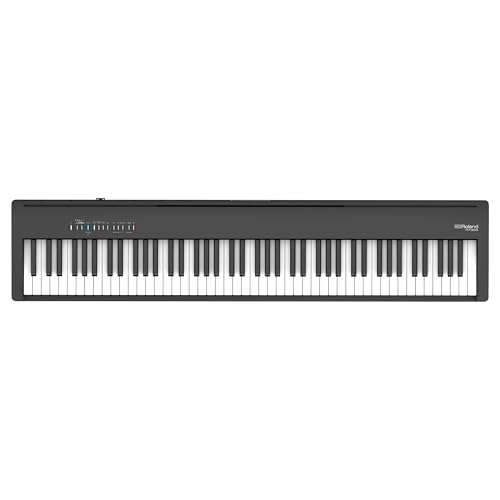
The Roland FP-30X is the middle model in Roland’s FP-X portable piano line, and Roland calls it the “sweet spot” of the series. It borrows the same 88-note PHA-4 Standard keyboard that sits in the more expensive FP-60X, adds Bluetooth audio and MIDI, and fits on a desk or a stand. This profile pulls together what Roland publishes, explains who the FP-30X suits and lists what to double-check before you buy. If you are still choosing between models, start with our best digital pianos of 2026 comparison.
We write from Roland’s published specifications and press materials, not from our own measurements, and we attribute claims to Roland where they are the company’s own.
Who the FP-30X Is For
It suits adult beginners and students who want a real piano touch from day one. Roland describes the PHA-4 Standard keyboard as having hammer action, escapement and Ivory Feel keys, with a heavier hammer feel in the bass and a lighter one in the treble. That graded behavior is what most teachers look for, because technique built on a weighted action carries over to an acoustic piano.
It suits returning players. If you played as a kid and want a compact instrument for evenings, the FP-30X offers a keyboard Roland says is the same as the one in its FP-60X, so you are not giving up touch to save space. The dedicated Roland Piano App and Bluetooth audio make it easy to follow an online lesson, a backing track or a favorite recording.
It suits small homes. Roland lists a footprint of about 51-3/16 inches wide by 11-3/16 inches deep with the music rest detached, and a weight of 32 lb 11 oz (14.8 kg) with the music rest. That is light enough to move between a bedroom and a living room, and Roland describes a desktop setting that adjusts the sound when the piano sits on a table instead of a stand.
It suits families with a teacher in the mix. The twin piano mode splits the keyboard so a student and teacher can play in the same range side by side, and the two headphone jacks let both people listen privately.
Who Should Skip It
Skip it if you want a three-pedal feel out of the box. The FP-30X ships with a DP-2 pedal switch, and Roland lists the DP-10 damper pedal and the KPD-70 three-pedal board as options. Roland’s connector table says pedal input 1 can detect continuous damper movement when an optional pedal is attached, so half-pedaling is possible with the right accessory.
Skip it if you want a piece of furniture. The FP-30X is a slab piano. Roland sells the KSC-70 stand to give it an upright look, and with that stand and the music rest the piano measures about 36-11/16 inches high. If you want a cabinet with built-in pedals, look at a console instead, such as the Yamaha Arius YDP-165 or the Roland RP107 in our lineup.
Skip it if you want the biggest, richest speaker system. Roland’s spec sheet lists two 4-3/4 inch (12 cm) speakers at 11 W each. That is a step up from the FP-10, but the FP-90X and FP-60X in the same family move up again. If sound in a large room matters, plan on external powered speakers, which the FP-30X supports through its 1/4-inch output jacks.
Keyboard and Touch
The PHA-4 Standard keyboard is the main reason to consider the FP-30X. According to Roland, it uses high-resolution sensing and escapement, a small notch-like mechanism that reproduces the slight “click” you feel when you press a key slowly on an acoustic grand. Roland also says the white keys use a moisture-absorbing surface to recreate the texture of ivory.
The spec sheet lists five touch types plus a fixed-touch setting, which lets you make the keys lighter or heavier to suit your hands or to mirror the instrument you practice on at home or at a teacher’s studio. Roland does not list the keys as wooden, so this is a plastic-based hammer action. Players who want wood in the keybed should compare the premium models.
Sound Engine and Speakers
Roland builds the FP-30X around the SuperNATURAL Piano engine with 256-voice maximum polyphony. That number matters when you use the damper pedal, because each held note keeps sounding and can use more than one voice. At 256, long pedaled passages and layered sounds are unlikely to cut off notes, while the FP-10’s 96 voices are closer to the limit in dense playing.
The spec sheet gives 321 available tones, with 56 reachable from the front panel and all 321 reachable from the Roland Piano App. Those tones include electric pianos, organs, strings and synthesizers, according to Roland. Roland also lists effects for ambience and brilliance, and app-only settings such as lid position, string resonance, damper resonance, key off resonance and single note tuning, plus temperament options. The Piano Designer settings are changed only through the app, and Roland notes that app support may end without notice, so do not buy the FP-30X for the app alone.
The stereo speaker system is two 4-3/4 inch (12 cm) drivers at 11 W each, and Roland’s feature list calls it a 22-watt system. Roland says the pair “deliver surprising power” for a portable piano. For a bedroom or small living room that should be enough, and for a band rehearsal or house party you can connect powered speakers.
Bluetooth audio (version 3.0, with SCMS-T content protection) streams music from an iPhone, iPad or Android device through the speakers or headphones. Bluetooth MIDI (version 4.0) links the piano to apps such as the Roland Piano App, GarageBand and Roland’s Zenbeats. A USB computer port handles USB MIDI and audio, and a USB memory port plays standard MIDI files and audio files (WAV and MP3) from a flash drive of 32 GB or smaller.
Practice features include a metronome with adjustable tempo, beat, volume and tone, transpose in semitones, split, dual and twin piano modes. A one-song, one-part recorder saves standard MIDI data at about 500 KB per song, which is fine for hearing back a practice run, though the Roland Piano App handles more elaborate recording. There are 30 internal songs. Master tuning runs from 415.3 to 466.2 Hz in 0.1 Hz steps.
For quiet practice, two headphone jacks, a quiet action and a speaker auto-mute feature round things out. Power draw is about 4 W when playing at medium volume, according to Roland.
Size, Weight and Setup
Roland lists 51-3/16 inches wide, 11-3/16 inches deep and 6 inches high with the music rest detached. With the KSC-70 stand, KPD-70 pedal unit and music rest, weight is 50 lb 12 oz (23.0 kg). On its own, with the music rest, the piano is 32 lb 11 oz (14.8 kg). Roland says the FP-30X is available in black or white.
Setup is simple: attach the music rest, plug in the AC adaptor and connect the DP-2 pedal switch. Think about where it will live. A desk or dresser needs to be sturdy and about 52 inches wide. Roland lists the KS-11Z, KS-13 and KS-20X keyboard stands if you prefer an X-style or two-tier stand to the dedicated furniture-style one.
FP-30X vs. Neighboring Models
Against the entry Roland FP-10, the FP-30X adds a more capable sound engine, 256 voices instead of 96, bigger speakers, a second headphone jack, dedicated output jacks and Bluetooth audio. Both share the PHA-4 Standard keyboard, according to Roland. If your budget is tight and you mostly practice on headphones, the FP-10 gets you the same touch for less, but you give up the speaker power and audio-streaming features.
Against the Yamaha P-225, the comparison is mostly about taste. Yamaha says the P-225’s GHC keyboard reproduces the playing comfort of its earlier GHS keys, and Yamaha lists 24 voices and a CFX concert grand sample. Roland lists many more tones and more polyphony. Whichever keyboard action feels better under your fingers is the one to pick, so check the seller’s return policy before you buy.
Questions to Ask Before You Buy
- Do you need a three-pedal feel? Budget for the KPD-70 board and KSC-70 stand, or consider a console.
- Will you use it mostly on headphones? The two jacks and quiet action serve that well.
- Do you want to record or learn with apps? The Roland Piano App and Bluetooth are useful, but app support is not guaranteed forever.
- Do you need room-filling sound? Plan on external speakers.
- Is your surface sturdy and about 52 inches wide? A wobbly stand can ruin the feel of a good keyboard.
Bottom Line
The Roland FP-30X is a well-rounded portable piano for beginners, returning players and apartment dwellers who want serious touch and modern connectivity without paying for a flagship. It trades pedals and furniture for portability, which is the right trade for many homes. For the full ranking, see our best digital pianos of 2026 comparison.
See price on Amazon
Sources