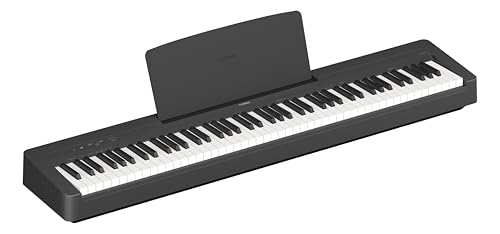
The Yamaha P-145BT is the entry-level model in Yamaha’s P Series, and Yamaha says it is the most compact piano in that line. It packs 88 weighted keys, a grand piano voice, a metronome and Bluetooth audio into a body that weighs about 24 lb 8 oz. This profile covers what Yamaha publishes, who the P-145BT fits and what to confirm before you buy. If you are still choosing, our best digital pianos of 2026 comparison ranks it alongside the rest of the field.
We write from Yamaha’s published pages and store specifications, not from our own measurements, and we attribute claims to Yamaha where they are the company’s own. One detail to note: Yamaha’s overview page does not give a weight, and its U.S. store page lists 24 lb 8 oz (11.1 kg), which is the figure we use.
Who the Yamaha P-145BT Is For
It suits true beginners. Yamaha describes it as “perfect for beginners with a serious interest in playing the piano” and as suited to people who are unsure which instrument to choose. Because the keys are weighted and graded, a student builds finger strength and dynamic control that an unweighted keyboard does not teach.
It suits small homes and shared rooms. The body is 52-3/16 inches wide and about 10-9/16 inches deep, and Yamaha says the design is slim and light enough to “complement any room”. Headphone practice keeps late-night sessions private.
It suits families buying a first instrument without guessing at the future. It is the entry point of the P Series, and the essentials are covered: weighted keys, a footswitch, a metronome and a power adapter all come in the box. For the same keyboard action with more features, look at the Yamaha P-225.
It suits players who want to practice with recordings. Bluetooth audio lets you stream a lesson or a favorite song through the piano’s speakers and play along, according to Yamaha.
Who Should Skip It
Skip it if you plan to play for years and want room to grow. Polyphony is 64 notes, and Yamaha lists only 10 voices, 4 reverb types and one Sound Boost type. A player who uses the sustain pedal heavily or layers sounds will find the limit sooner than on the P-225 (192 notes) or the Roland FP-10 (96 voices per Roland).
Skip it if a teacher will sit beside you with headphones. Yamaha lists a single standard stereo headphone jack. Duo mode lets two people play in matching ranges, but both would hear it through the speakers, or you would need a splitter.
Skip it if you want line outputs. The spec table lists headphones, USB to HOST and DC IN connections but no AUX output. If you need to feed a PA or amp, the P-225 offers AUX OUT jacks.
Skip it if you want a wooden or premium keyboard. The GHC keyboard has matte black keytops, and Yamaha does not describe wooden keys or escapement here.
Keyboard and Touch
Yamaha says the GHC (Graded Hammer Compact) keyboard offers the same weighted, acoustic-like feel as the GHS keys of earlier P-series models in a shorter, thinner body. The store page says the 88 touch-sensitive keys deliver “a natural acoustic piano feel”.
Touch sensitivity has four settings: hard, medium, soft and fixed. A hard setting asks for more finger force to reach a loud note, a soft setting responds to a lighter touch, and fixed makes every note the same volume. Most beginners will leave it on medium.
Sound, Voices and Resonance
The piano sound is the Yamaha CFIIIS, which Yamaha calls the origin of its premier CFX concert grand. Yamaha says it was sampled from a piano with a bright, transparent tone and spacious treble. Damper resonance reproduces the extra ring you hear when the pedal is pressed, and the spec table lists it as “Yes”.
There are 10 voices, including grand pianos, electric pianos, organs, harpsichord, strings that layer well over piano, and Accordion and Di Zi voices. Dual mode blends two voices, such as piano and strings. Yamaha lists 10 voice demo songs and 10 piano preset songs, which are useful for hearing the instrument and for practice material.
Speakers are two oval units (4-3/4 by 3-1/8 inches, or 12 by 8 cm) at 7 W each, firing from the rear, and Sound Boost can push the sound further. Rear-firing speakers sound best with a bit of space behind the piano.
The built-in metronome runs from 32 to 280 beats per minute. Transpose covers six semitones either way and tuning runs from 414.8 to 466.8 Hz. Duo mode splits the keyboard into two identical halves, each with its own middle C.
The Smart Pianist app controls settings, offers built-in lessons and plays sheet music on your phone, according to Yamaha. Rec’n’Share records audio and video for sharing. Bluetooth audio and USB to HOST (MIDI and audio, 16-bit, 44.1 kHz) connect a phone, tablet or computer. Power consumption is 6 W with the PA-150B adapter.
Size, Weight and Setup
Without the music rest the piano is 52-3/16 inches wide, 5-1/16 inches high and 10-9/16 inches deep. With the music rest the height is 12-1/16 inches and the depth 12-5/8 inches. It weighs 24 lb 8 oz (11.1 kg). With the optional L-100 stand, Yamaha gives a height of 29-5/16 inches (36-5/16 inches with the music rest).
Included are the owner’s manual, music rest, footswitch and an AC adapter, which Yamaha notes varies by area. Optional extras include headphones (HPH-150, HPH-100, HPH-50), the L-100 stand, the LP-5A pedal unit, an FC3A foot pedal, FC4A and FC5 footswitches, an SC-KB851 bag and the UD-BT01 wireless MIDI adaptor.
For practice, pick a stand or desk that is sturdy and at least 52 inches wide. A flexible stand makes the keys bounce under your hands, which is distracting when you are learning.
P-145BT vs. Neighboring Models
Against the Yamaha P-225, the P-145BT loses polyphony (64 vs. 192), voices (10 vs. 24), VRM Lite, the recorder, rhythms, a second headphone jack and the AUX outputs, according to Yamaha. It is slightly lighter, by under a pound on Yamaha’s numbers, and is Yamaha’s simplest option. If your budget is firm and you value simplicity, that may be what you want.
Against the Roland FP-10, both are entry-level weighted-key portables. Roland says the FP-10’s keyboard has escapement and Ivory Feel and lists 96-voice polyphony. Yamaha offers Bluetooth audio for streaming songs, while Roland’s FP-10 page lists Bluetooth MIDI only. Yamaha’s design is slightly lighter. Pick the keyboard whose feel you prefer, and read the return policy where you buy it.
Questions to Ask Before You Buy
- Is Bluetooth audio included on your unit? Yamaha says it varies by area.
- Will a teacher or partner need a second headphone jack? If so, consider the P-225.
- Do you want pedals? The footswitch is included; the LP-5A is an extra.
- Is 64-note polyphony enough for how you play? For slow beginner pieces, usually yes.
Bottom Line
The Yamaha P-145BT is a simple, light, approachable weighted-key piano. It leaves out some of the polish of the P-225, but it keeps the things that matter most to a first-time player: a graded action, a respected grand piano sound, Bluetooth streaming and a footswitch in the box. For the full ranking, see our best digital pianos of 2026 comparison.
See price on Amazon
Sources