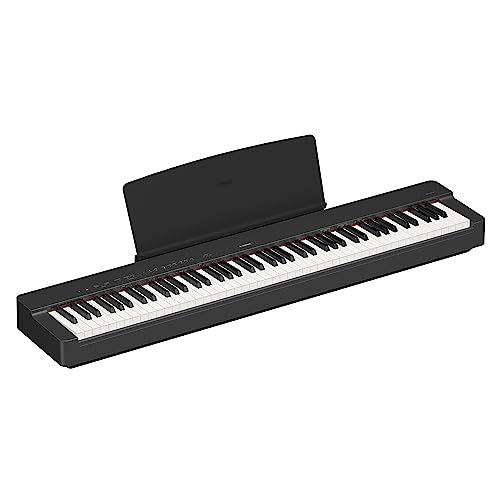
The Yamaha P-225 is a compact, weighted-key digital piano that sits in the middle of Yamaha’s P Series. Yamaha describes it as a “stylish digital piano with the playing feel of a full-fledged grand” and says it is built to suit advanced players and serious beginners alike. It pairs a new GHC keyboard with the sound of Yamaha’s CFX concert grand and adds extras such as a recorder, rhythms and an AUX output. This profile summarizes what Yamaha publishes, who the P-225 fits and what to confirm before you order. For the whole field, see our best digital pianos of 2026 ranking.
We write from Yamaha’s published product and store pages, not from our own measurements, and attribute claims to Yamaha where they are the company’s.
Who the Yamaha P-225 Is For
It suits beginners who want to grow into it. Yamaha says it recommends the P-225 for players who want a weighted keyboard that feels like an acoustic piano, people who want a piano at home without much space and people who want a second piano. A weighted action is generally the better foundation for learning, since the muscle memory carries over to an acoustic upright or grand.
It suits families that already trust the Yamaha name. Smart Pianist, Yamaha’s app, controls settings and offers built-in lessons and a Sheet Music Reader for PDFs, according to Yamaha. The Rec’n’Share app records audio and video of your playing to share online, though it needs a cable that is sold separately.
It suits small spaces. Yamaha lists a width of 52-3/16 inches and a depth of 10-11/16 inches (14-1/4 inches with the music rest), and a weight of 25 lb 6 oz (11.5 kg). Yamaha calls it “much shorter and thinner” than its predecessor, which matters if you have a narrow desk or console table.
It suits players who want a feature step above the P-145BT but not a flagship. The P-225 lists 24 voices to the P-145BT’s 10, a recorder, a split mode, a rhythm section and a second headphone jack.
Who Should Skip It
Skip it if you want a wooden keybed. Yamaha lists matte black keytops on a GHC keyboard and does not describe wooden keys or escapement on this model. The premium Yamaha P-525 in our lineup moves to a wooden-key action.
Skip it if you need a true three-pedal setup out of the box. The P-225 includes a sustain footswitch. Yamaha lists an LP-1 three-pedal unit and an L-200 stand as options, so a furniture-style setup costs extra. A console piano such as the Yamaha Arius YDP-165 comes with pedals built in.
Skip it if you want the loudest speakers. Yamaha lists 7 W x 2 amplification, with each side pairing an oval 4-3/4 by 3-1/8 inch (12 by 8 cm) speaker with a 2 inch (5 cm) speaker. That suits a bedroom or living room. For bigger spaces, use the AUX OUT jacks.
Keyboard and Touch
The GHC keyboard is the P-225’s headline. Yamaha says it developed the GHC to allow a smaller chassis while offering the same weighted, piano-like feel as the GHS (Graded Hammer Standard) keys of earlier P-series models. “Graded” means the keys are heavier in the bass and lighter in the treble, as on a real piano, a point Yamaha repeats in its store copy.
The spec table lists four touch sensitivity settings: hard, medium, soft and fixed. Fixed makes every key strike the same volume, which can help for organ or harpsichord sounds, while hard makes you work harder for a loud note. If you tend to play too loud or too soft, adjusting this setting helps the piano match your touch.
Sound and Resonance
Yamaha says the P-225 uses a sample of its CFX concert grand, “with shimmering highs and powerful lows”, and applies Virtual Resonance Modeling (VRM) Lite, which recreates string resonance that changes with how hard you press the keys. Polyphony is 192 notes. The spec table also lists Intelligent Acoustic Control (IAC), which Yamaha says automatically adjusts sound quality to your volume setting, and a Stereophonic Optimizer that makes headphone sound feel more spread out, as if you were sitting at an acoustic piano.
Sound Boost has two types on the P-225. Yamaha says it brings out the piano’s presence when you play with other instruments or in noisy rooms. Reverb offers four types, and a Wall EQ is listed, and Yamaha says the speaker placement is tuned for playing with the piano against a wall.
There are 24 voices, including several grand pianos, Stage E.Piano, DX E.Piano, Jazz Organ and Strings, plus E.Clavichord and Vibraphone. Dual mode blends two voices, split divides the keyboard into two zones and duo mode splits it into two identical halves for a lesson with a teacher. Yamaha lists 21 voice demo songs and 50 classics.
A metronome with a 5 to 280 tempo range, transpose of six semitones either way and tuning from 414.8 to 466.8 Hz are listed. A recorder holds one song of two tracks, about 100 KB or 11,000 notes, which lets you play a right-hand part and then add the left. Yamaha lists 20 rhythms in genres such as rock, pop, jazz and bossa nova, for practicing with accompaniment.
For connectivity, USB to HOST handles both MIDI and audio, and Yamaha lists a 44.1 kHz, 24-bit stereo audio interface. Bluetooth audio streams music through the speakers, and Yamaha says it varies by country, so check that your unit includes it. There are two standard stereo headphone jacks and AUX OUT jacks. Power consumption is 9 W with the PA-150B adaptor.
Size, Weight and Setup
On its own the piano is 52-3/16 inches wide, 5-1/16 inches high (12-7/8 inches with the music rest) and 10-11/16 inches deep. With the L-200 stand the height rises to 29-5/16 inches without the music rest and 37-1/16 inches with it. It weighs 25 lb 6 oz.
Yamaha says the P-225 is available in black or white. The optional soft case, a keyboard bag listed as the SC-KB851, makes it easier to carry to a lesson or gig. The listed AC adaptor is the PA-150B, and Yamaha says the adaptor varies by area.
Setup takes a few minutes: attach the music rest, plug in the adaptor and connect the footswitch. Put it on a sturdy desk or stand with at least 52 inches of width, and keep it level so the keys sit evenly.
P-225 vs. Neighboring Models
Against the Yamaha P-145BT, the P-225 has more voices (24 vs. 10), higher polyphony (192 vs. 64), VRM Lite, a recorder, a rhythm section and a second headphone jack, according to Yamaha’s spec tables. The P-145BT is the simpler and lighter option, at 24 lb 8 oz per Yamaha’s store page.
Against the Roland FP-30X, the P-225 is lighter by a few pounds on paper (25 lb 6 oz vs. Roland’s 32 lb 11 oz with music rest) and brings Yamaha’s CFX sound. The Roland offers more polyphony (256) and a larger tone library, and lists a keyboard with escapement and Ivory Feel. If key action matters most to you, compare the two before you buy.
Questions to Ask Before You Buy
- Is Bluetooth audio included on the unit sold to you? Yamaha says it varies by country.
- Do you need three pedals? Add the LP-1 and L-200, or choose a console.
- Will you record yourself? The two-track recorder and Rec’n’Share app help.
- Do you want to play with teachers or partners? Duo mode and two headphone jacks suit that.
Bottom Line
The Yamaha P-225 is a thoughtful compact digital piano for beginners and second-piano buyers who want a weighted action, a respected grand sample and plenty of practice tools without a large footprint. It does not have a wooden keybed or built-in pedals, but it earns its place for flexibility and portability. See the full ranking in our best digital pianos of 2026 comparison.
See price on Amazon
Sources